Long Break Allowed Honda to ‘Course Correct’ with Prelude
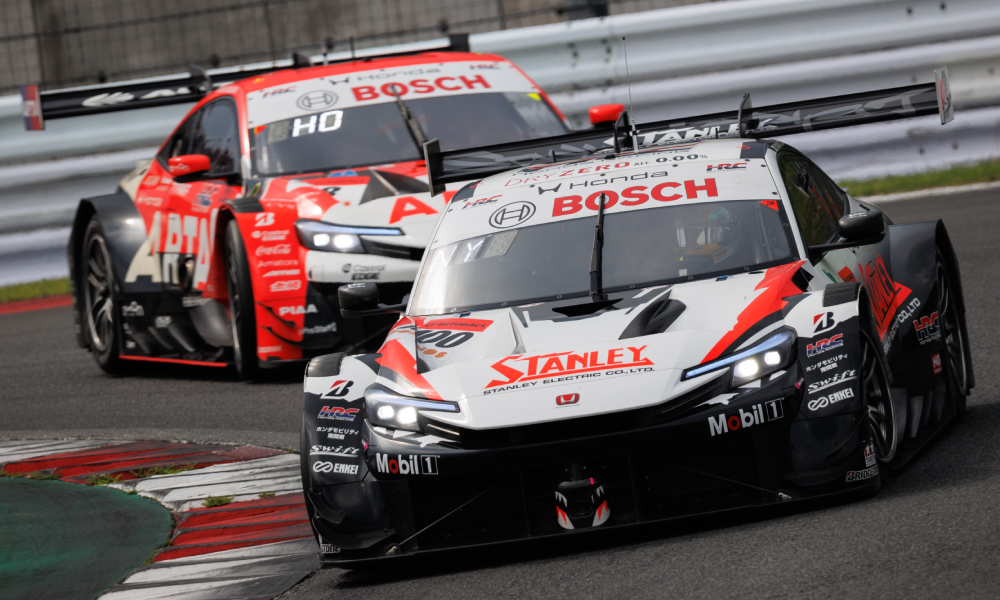
Photo: Honda
Honda believes the three-month gap between SUPER GT races was critical in allowing it to ‘course correct’ after a difficult start to life with its new Prelude GT500 challenger, after picking up its first win of the season this month at Fuji Speedway.
Team Kunimitsu pair Naoki Yamamoto and Tadasuke Makino delivered the new Honda HRC Prelude-GT’s first win after coming out on top in a close battle with another of the Honda crews, Kaku Ohta and Hiroki Otsu in the No. 8 ARTA car.
The milestone win came in the car’s third race, and followed best results of sixth in each of the first two rounds at Okayama in April and then at Fuji in early May.
Honda GT500 project leader Tomohiro Onishi said that the extended break since the previous round at Fuji in May, owing to the cancellation of the Sepang race in June, provided the marque with a golden opportunity to figure out what had gone wrong.
“After the first two races, I spent some time thinking, ‘Why has it gone so badly?’,” Onishi told reporters post-race at Fuji.
“We believed we had broadly met our development goals, and the results weren’t there. I wouldn’t go so far as to say that it made me think our entire development philosophy was wrong, but certainly it shook our confidence.
“Before this round we had a long break, which allowed us to find things to improve and adjust things even among areas that we assumed we were already doing well.
“I think in the past we have been guilty of thinking everything is ok even when good results came just by chance, and there was no time to properly reflect.
“But this time, we had two poor results, and we finally had the time we needed to look carefully at everything. By starting with a clean slate and discussing things with all the engineers from the teams and the drivers, we made new realizations.
“Although our confidence dipped, we made a course correction, we got a good result and now we can tell ourselves again to be confident.”
While GT500 rules do not allow new parts to be introduced mid-season, Onishi explained that wholesale set-up changes made to the Prelude had allowed the four Bridgestone Honda crews to extract more performance and longevity from their tires.
Asked where in particular the Prelude was now showing superiority to Toyota and Nissan, Onishi replied: “Some of the drivers told me post-race that braking and high-speed cornering was extremely strong during the race, so I think those are the strong areas.
“Sector three [at Fuji] was a weakness for us previously, but now but we were able to get good times in qualifying. But given the comments from the drivers about braking and high-speed cornering, I don’t think we have reached a level where we are more competitive than the other cars in sector three in a race situation.”
While satisfied with the progress Honda has made for now, Onishi admitted that beating the No. 36 TOM’S Toyota to the title remains a tall order.
He pointed out the fact the car shared by Sho Tsuboi and Kenta Yamashita finished fourth at Fuji despite carrying a nominal 80 kg success handicap — putting it ahead of both the Real Racing and No. 16 ARTA Preludes that also use Bridgestones.
“We were definitely helped by the success ballast situation this time,” admitted Onishi. “When you look at the results, the car with the biggest handicap finished fourth, and ultimately that is the car we will have to challenge [to win the title].
“If we were heading to the last round for a straight battle with no success weight, I would say we still aren’t on that level yet. I think we need to make another leap in performance similar to the one we made during this three-month interval.”
Yamamoto and Makino face a 21-point deficit in the championship to Tsuboi and Yamashita, who won the first two races, heading into next week’s Suzuka round.
Source: Sports Car 365